
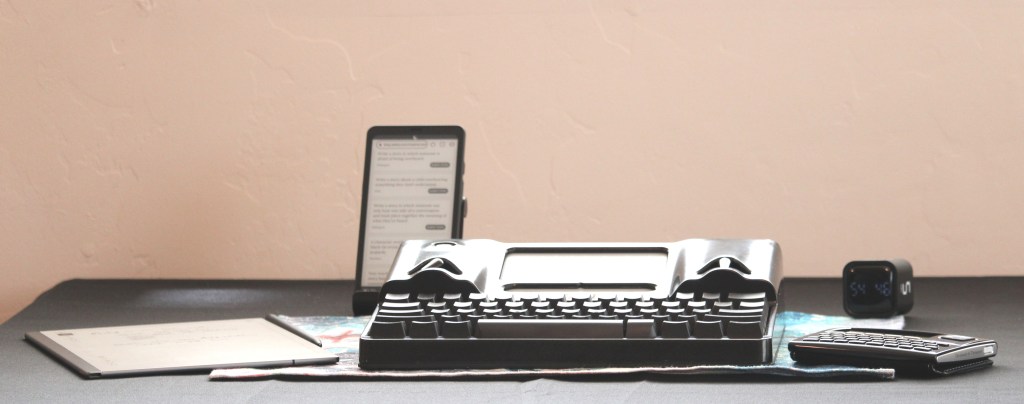
I am a gearhead. I love taking things apart, building contraptions, and using the right tool for the job. I enjoy trying new tools, discovering specialized devices, and collecting a variety of options when it comes to building out customized toolboxes.
So it should come as no surprise that, being a child of the 80s, I became obsessed with “personal electronics” and all the wonderful things they could do. And now, in the age of smartphones and do-everything laptops, I continue to seek out the best specialized devices for my hobbies.
Here you will find a regularly curated list of my favorite tools for writing. I will include a wide range of options, and eventually I’ll be making videos that explore each device in depth. For now, please feel free to send your questions or suggestions to my email address, mermaidpiratedispatch@gmail.com to help make this list even better!
Writing Tools and Gear
- Good old fashioned pen and paper.
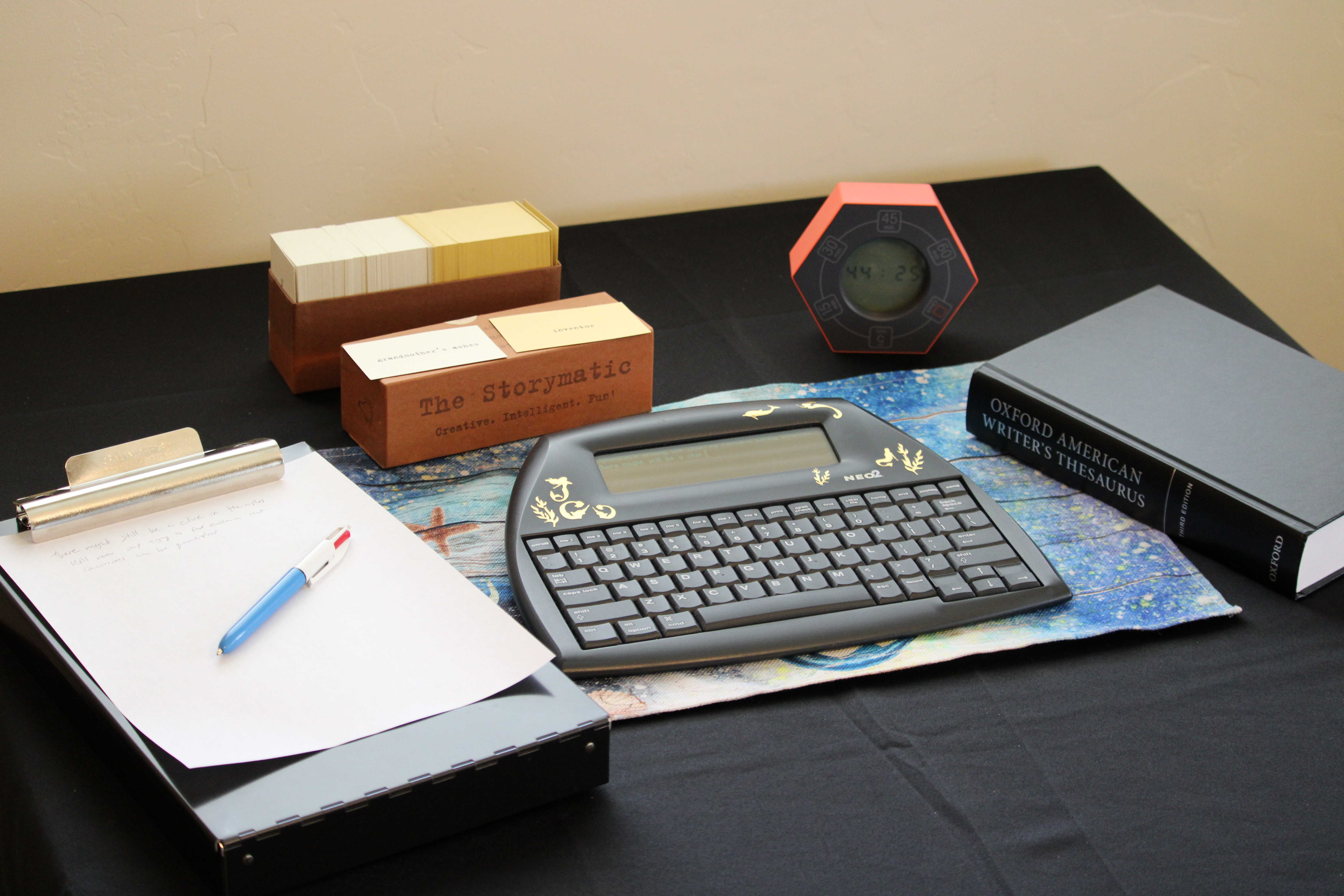
- I have two favorite pens. The traditional BIC Round Stic and the BIC 4-Color. The Round Stic is great because they can be had for super cheap (in bulk) and they always work great. They are reliable and you can just carry a few around with you and you don’t have to worry about losing them or giving them away. My love of the 4-Color pens might be driven a bit by nostalgia, but they are also super reliable and the additional colors are great for notes and detailed maps or doodles.
- I love this aluminum storage clipboard from Saunders. I have two of them (one black and one silver) and they are great for storing pens, pencils, erasers, whiteout, and whatever else you might need as well as a stack of loose paper or pads of paper. If you prefer writing by hand, this is the best clipboard to transport your writing implements and write on the go.
- For a while I tried out the Rocketbook Reusable Smart Notebook. These pads of special paper require a special pen/ink but for some people they might be perfect. They are essentially a notebook that can be completely cleaned off and reused over and over again, using a special app that interfaces with the paper to record and organize your notes. I personally found that other products listed below (which are more expensive in most cases) fit my needs much better and were more convenient, but I wanted to mention these pads as an option in case they appeal to you!
- Computer.
- Personally, I don’t write directly on the computer for my first draft (see the “Dedicated writing device” section below) because I like to minimize distractions. However, whether you use a cheap Chromebook or a fancy desktop setup, do yourself a favor and try using a nice ergonomic keyboard. I’ve tried at least a half dozen models, and my favorite (by far) is the Logitech ERGO K860. It’s a bit pricey, but it works great, has amazing battery life, and really has made a difference for my wrists. Similarly, if you find yourself using a mouse for long periods of time, get a vertical mouse. Your wrists will thank you.
- Dedicated writing device.
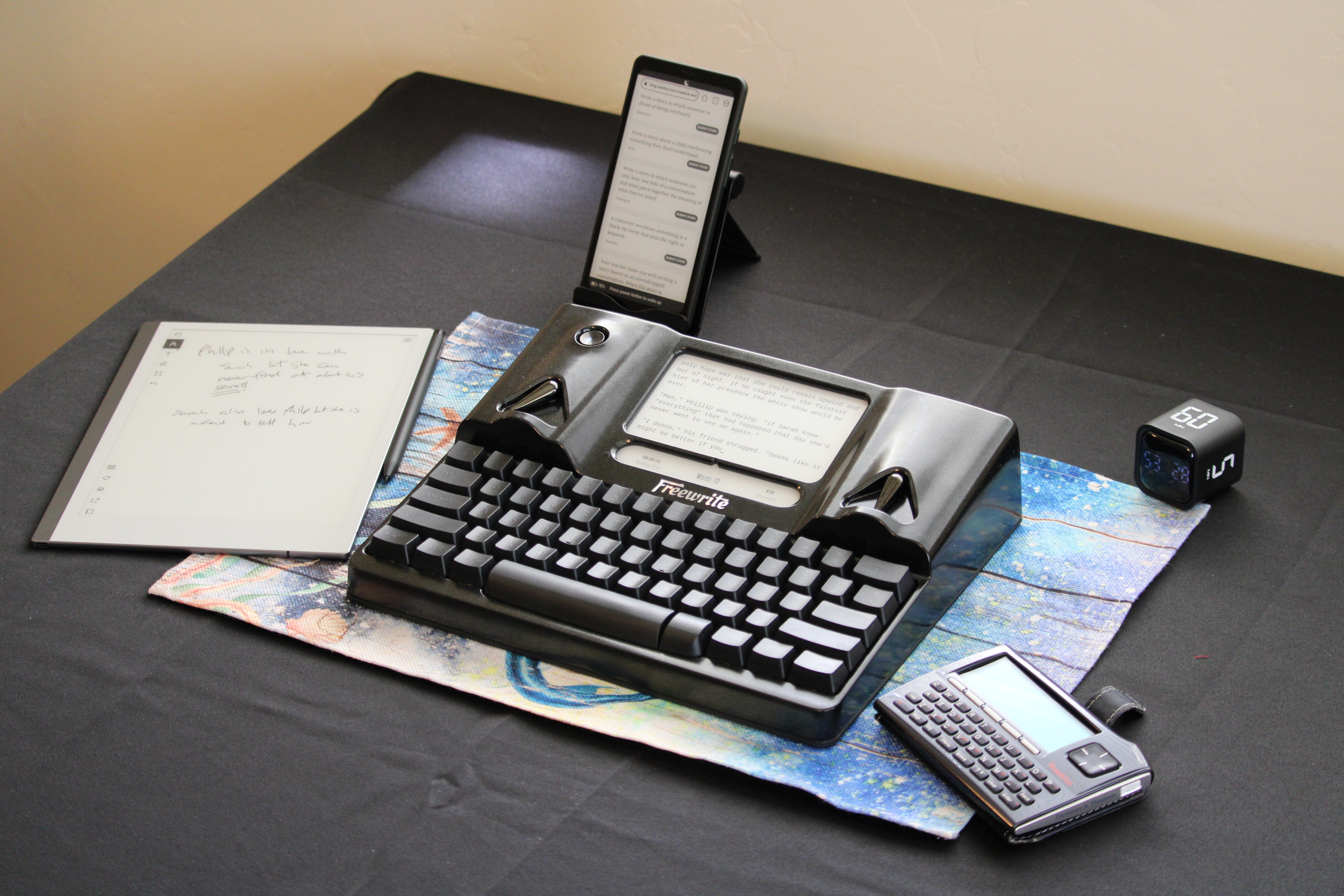
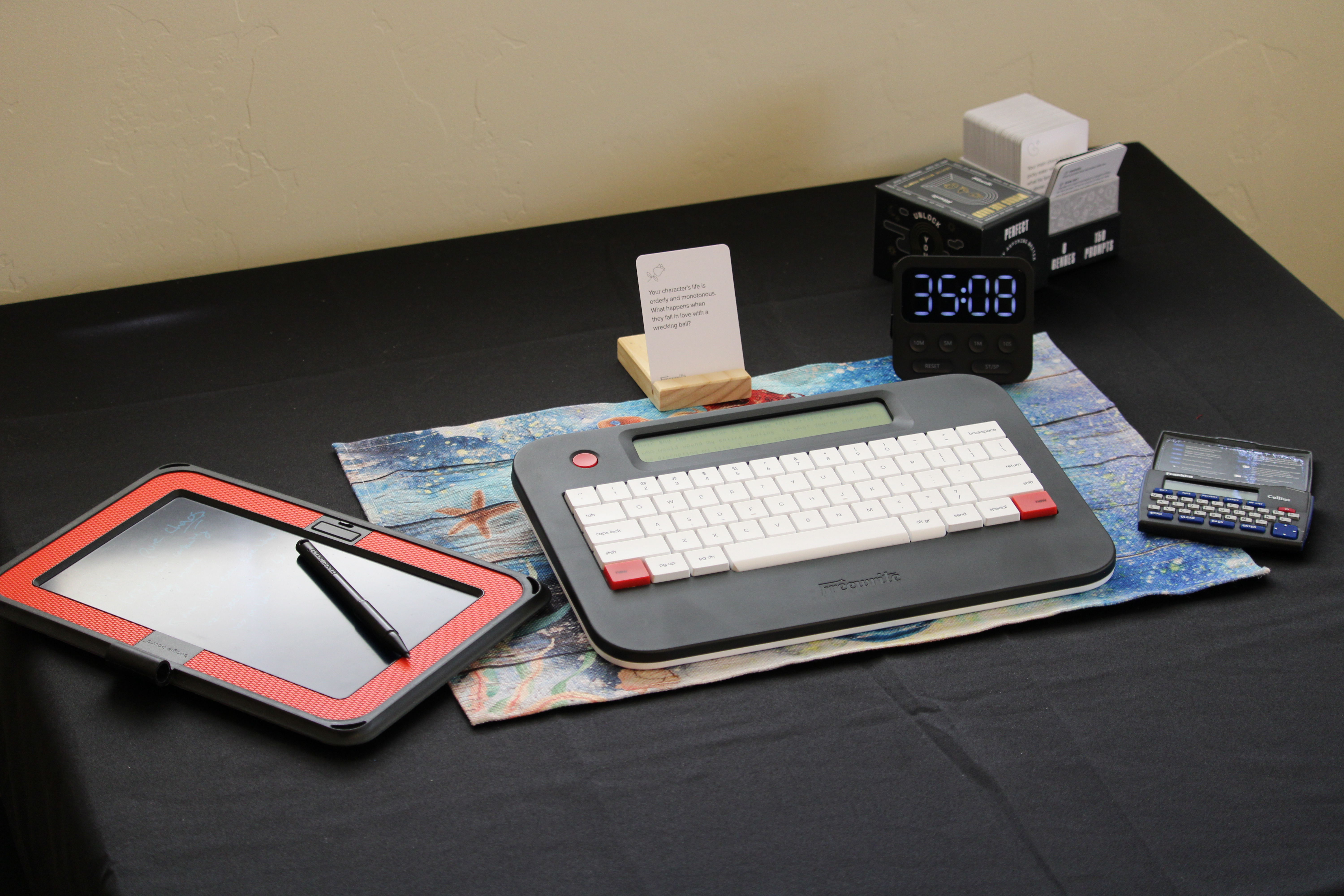
- I know it’s cliché at this point, but I derive a great deal of satisfaction from the “modern typewriter” approach to writing, especially for my first drafts. These devices are not meant to be used for editing, layout, or publication. They are meant for writing and only writing. Again, I’ve tried a variety (I will publish videos about them at some point on my YouTube channel), but my favorites by a huge margin are the Freewrite devices by Astrohaus. Their most expensive model, the Smart Typewriter, is my very favorite and the one I use most of the time. I haven’t tried their Traveler model, but I have heard the experience is similar to the original Smart Typewriter just with a chiclet style keyboard instead of mechanical switches (I’m not a keyboard connoisseur, so my opinions on switches should be largely ignored). However, if you don’t mind the chiclet keys, I can definitely recommend their Alpha model over the Traveler based on price alone. The Alpha might be a tad bit larger, but it fits nicely in every book bag I own, making it versatile and portable enough for me.
- And speaking of the Freewrite Alpha, that device was directly inspired by the Alphasmart Neo, another device I can recommend (though I doubt I can maintain a good, reliable link for purchase). These are older devices that you will have to find used and will usually need a good cleaning. They aren’t great for long drafts, but if you are doing short stories or writing just a chapter or two at a time on the go, I do love their simplicity. I’ve even been able to take mine apart and make repairs myself on several occasions. If you’re lucky you can snag a used one for under $50 on eBay, making them one of the most affordable dedicated electronic writing device options.
- Miscellaneous gadgets.
- While I’m writing on my Freewrite I like to have a note-taking device handy. For you that might just be a pad of paper, but I love my reMarkable 2 with the Marker Plus. My goodness this device is a marvel of engineering. It is the thinnest tablet device I’ve ever seen and it works great. I have zero complaints, except that it is expensive. If you can afford it, you won’t regret the purchase. Use it to write your stories directly and have their software convert the handwriting to text that can be pasted into an editor, or just use the device as an advanced, flexible notepad for notes, drawings, or research. This device pairs so nicely with the Smart Typewriter that it makes me feel like a tech-enabled Earnest Hemingway superhero.
- If the reMarkable is too expensive but you still want a modern way to scribble random notes while you write, consider one of the many Boogie Board products. I love the Boogie Board Jot and use it regularly, though while writing it has mostly been replaced by the reMarkable. You know what the Boogie Board is really good for though? I keep one by the shower so I can quickly note down any thoughts I might have, which I then transfer to the reMarkable after drying off. While Boogie Boards can’t save and recall data on their own, they are an excellent temporary scratch pad (and if you really need multiple pages, your smartphone’s camera can save each “page” as needed). Plus they are cheap. I have at least five of these things scattered throughout my house and I use them daily.
- Do you want to feel fancy and modern with your electronics while also going for that retro, anti-distraction vibe? Get a calculator watch. Seriously. Just do it.
- I love writing with a timer going. Whether I’m trying to write one flash fiction short story in 30 minutes or using the pomodoro method to focus, having an easy-to-use digital countdown timer is essential to me. I have two that I love and use regularly. The first, a hexagonal rotating productivity timer, has a great LCD screen. I use this for almost all of my writing sessions. The only problems are that it doesn’t read well in low light (especially with the screen recessed so deep in the body) and it doesn’t offer as many timer options as other devices. That’s where the dodecagon time ball comes in. This one is USB-C rechargeable (the hexagon uses 2 AAA batteries) and it offers far more options for its countdown timer. Of course, it also doesn’t have a screen so you can’t glance and see how much time remains. Both options are amazing, depending on your personal needs and style. Most recently I’ve been using a cube timer. It doesn’t offer as many timing options on the faces (I prefer 45 minute writing sessions, a value it is missing) but it is USB-C rechargeable, compact, easy to see in all lighting, and it can be set manually to any time you want.
- Since I’m minimizing distractions, I want to limit my ability to dive into rabbit holes, fly off on tangents, and wind up scrolling the news or playing a game. That’s where my specialized electronic reference tools come in. Sometimes I’ll get hung up on a word. Maybe I can’t remember the “I before E rule” for a particular exception (is weird an exception?). So I pull out an electronic thesaurus/dictionary. These little devices are amazing. I have two that I love, though there is a clear winner between them. The first one I bought was the Franklin DMQ-221. This is an amazing little device, and if you don’t know about the other option, it’s perfect. However, once I discovered the Franklin MWD-1510, I knew I had to upgrade. The only trouble is that the DMQ-221 can be had new for just around $40 while the MWD-1510 is rarely available used for less than $100. The Amazon listing currently has it at $350 (and I do not recommend paying that price!). If you can find it under $100 then I highly recommend the MWD-1510. It has better spelling correction, a larger dictionary/thesaurus, and a bigger screen. It’s just a better device in every way. But I love my DMQ-221 as well.
- While it’s not as distraction-free as a dedicated electronic dictionary/thesaurus is, this next device (with a little discipline) can be the ultimate reference device for a low-distraction writing setup. The BOOX Palma is essentially an e-ink reader and cellphone hybrid device. The e-ink screen is quick enough to be usable but slow enough to discourage diving too deep into the rabbit holes you’ll come across. It has a built-in dictionary app but I find that just pulling up Google is a better way to find those hard-to-spell words. It lasts a long time on a single charge, and you can configure the sleep mode lock-screen to just keep showing what you had on it at the time (great for leaving reference notes or materials on the screen while the device is “asleep”). I never sit down to write without the Palma since it allows me to keep my cell phone and it’s temptations far away while still letting me access basic Google functionality.
- Finally, if you’re taking all these gadgets on the go to write, you might want a good battery bank to top things off without being tied to a wall outlet. The Anker Prime Power Bank is amazing. At over 20,000mAh I think it’s too big to bring on an airplane (last I heard, you were limited to 10,000mAh batteries on aircraft) but if you’re on the road or just writing away from the house for a while, this device is amazing for keeping your devices charged and operational.
Writing Prompts, Reference, and Advice
- The Storymatic is a really fun writing prompt system that comes in a variety of flavors. There’s the classic, the “for kids” edition, and the Synapsis box. I love these and have used them many times while writing with my daughter or just for fun.
- Astrohaus has a deck of prompts they call Words are Hard. I use these cards for my blog stories pretty frequently. They are great and many of the prompts will push you out of your comfort zone in a good way. Highly recommended!
- Rory’s Story Cubes are a classic. They come in a variety of themes (including Star Wars, Harry Potter, and other brands as well as Mystery and Fantasy packs). I collected quite a few of their sets before realizing I had a problem.
- Similar to the story cubes, you have Two Tumbleweeds Writing Dice, and Garybank Inspiration Writing Prompt Dice. I love both sets (the Garybank set can be packaged with some cards as well).
- The Writer Emergency Pack XL is great for when you’re in the middle of a story and feeling stuck. It’s packed with tons of inspiration, tools, and helps for keeping your story fresh and exciting.
- The Oxford American Writer’s Thesaurus is one of my favorite books on my writing bookshelf. It’s like a regular thesaurus except that the vocabulary choices are specifically aimed at writers. It’s an amazing thing to have around and browse through from time to time. Just remember what Stephen King said: “Any word you have to hunt for in a thesaurus is the wrong word. There are no exceptions to this rule.” I don’t use the thesaurus to improve on a word I’ve already chosen, I use it to hunt for a word I know but can’t remember. Or sometimes I’ll just browse through it for inspiration. Please don’t use a thesaurus to force your language to sound more flowery or inspired!
- Roget’s has a similar product, the Thesaurus of Words for Writers. I recently ordered this and I imagine it will be similar to the Oxford offering. I’m a sucker for specialty reference books though, so I had to get it!
- Master Lists for Writers is a fantastic set of lists, thesaurus-like entries, and collections that can inspire your work and expand your horizons. I love it!
- Hooked is one of the best books I know of for writing good fiction. I haven’t read it in a while and I should probably re-read it now that I’m taking my writing more seriously. I highly recommend this book for any aspiring writer!
- Long Story Short does a good job of helping improve your writing. This one, I will confess, I haven’t read. But I’ve heard that it covers a few things in detail that Hooked grazes over or misses. I should read it so I can recommend it better!
- Self-Editing for Fiction Writers is an essential book for anyone who doesn’t already know how to edit a story for publishing. I’ve seen in many writing books that writing is really all about editing. Getting a draft out on “paper” is great, but knowing what to do next is absolutely critical. This book will help.
- The Elements of Style. This is a necessary evil for some people and a beautifully crafted tool for others. While not all of your writing needs to follow all of these rules all of the time, it is important to understand the elements of style so that your writing can be consistent and fluid for your readers.
Alright, that’s not all of the books, products, and tools that I use, but it’s some of my favorites (or the most significant, as I see them). I hope you found this list helpful. If you do decide to get any of the products listed, please consider using the affiliate links I’ve provided. It will help me out a ton!
 Mermaid Pirate Dispatch
Leave a comment